Bhote Koshi Flood Was a Warning. The Worst Is Yet to Come.
Bhote Koshi Flood Was a Warning. The Worst Is Yet to Come.
Glaciers along the Nepal–Tibet border are melting. This is no longer a scary tale. It is a grim reality for everyone living downstream. And yet it makes little noise in a world with too many ears, but too little time to listen. Ice does not scream loud enough to rupture our eardrums when it disappears. Mountains do not summon press conferences in glitzy rooms, surrounded by a forest of microphones and flashing cameras, to announce that their frozen reserves are vanishing.
But when melting glaciers suddenly unleash roaring torrents downstream, carrying rock, mud and debris, the silence is shattered and panic comes rushing down with the water. Roads vanish. Bridges snap. Hydropower plants surrender. Villages are swallowed beneath a thick carpet of sludge and debris.
The paradox? Himalayas whisper when they melt. They roar when we finally notice.
And then we are told by those blessed with their hindsight wisdom that chunks of rock and ice broke loose, sounding no alarm, crashed into glacial lakes and burst their banks. Rivers surged, walls of water rose like an angry anaconda uncoiling in pursuit of its prey. The eerie roar of the raging torrent drowned the heart-rending screams of women and children. Villages and towns were engulfed, people swept away, and their battered remains buried beneath a thick carpet of sludge and debris.
What the people on the Nepali side of the Nepal–Tibet border have endured is not a new chapter in the bewitching Himalayan book of parables. It is an old lesson, read aloud many times before in the South Asian school of the cryosphere, only to be quickly forgotten once the waters recede. What we have witnessed may be no more than a teaser of an apocalyptic saga for those willing to see beyond what meets the eye.
South Asia’s water woes could prove far more sinister than the horror that unfolded on August 26. What was unleashed by those bewitching, milky-white mountains, hurling rock, ice and water into the valleys, may be only the beginning of a far larger crisis. The real horror may lie in what comes next. Bridges can be rebuilt. Power plants can be reconstructed. Lives, of course, cannot.
But the greater danger may lie beyond the immediate devastation. The marauding swell of water delivered a warning as it rampaged through the Bhote Koshi – the Himalaya’s ancient water-regulating system is beginning to fray. What looks today like a lethal flood could become tomorrow a far more profound crisis of water instability; too much water at one time, too little when it is desperately needed.
The real question is not how terrifying and annihilating a flood melting mountains can unleash, but something far more unsettling. What happens when the frozen reservoir spread across the Himalayan snowy fields begins to crumble and Nature’s age-old water distribution system goes awry, delivering roaring floods at one time and thirsty rivers at another!
The threat that could soon haunt the two billion South Asians living across the Gangetic and Indus plains is something else that should keep us awake at night. What if creeping global warming punches a gaping hole in the Water Tower of Asia atop the Himalayas, rupturing the Himalayan reservoir that stores water as snow and ice and releases it gradually into the river systems that have sustained communities, farms, cities and industries across South Asia for centuries?
What if Nature’s carefully calibrated water-distribution system is thrown out of order; rivers running dry when we need water most, and roaring and raging when we need them least. This may sound like a far-fetched horror story, or a bogeyman tale meant to scare children. Unfortunately, it is not. The raw data alone is enough to make us shudder.
According to the latest ICIMOD report, published in March 2026, glaciers across the Hindu Kush Himalaya are losing ice at twice the rate recorded since 2000, while some glaciers have lost as much as 27 meters of ice thickness since 1975. Between 1990 and 2020, the HKH region lost about 12 percent of its glacier area.
And the snow is no longer being generous either. It has become erratic, unpredictable and deceptive. Another ICIMOD report, published in April 2026, found that snow persistence across the HKH had fallen 27.8 percent below the long-term average, breaking the previous year’s record low and marking the fourth consecutive year of below-normal snow persistence. Ten of the region’s 12 major river basins recorded below-normal snow persistence.
This is not simply a sorry sight about the enchanting, milky-white mountains of the north turning brown or black, changing color like a frightened chameleon, before the grieving eyes of those who see them from a low-flying aircraft. It is a story about South Asia’s plumbing system. And someone is slowly removing the pipes.
Nature’s ATM Is Running Out of Cash
Rapidly melting glaciers send greater volumes of water into rivers. Sounds like good news! It isn’t. Like ATM cash machines, glaciers are Nature’s automated teller machines. They store Nature’s savings in the form of snow and ice and dispense water gradually, season after season. Withdraw too much too quickly, however, and the machine may dispense plenty today only to leave us with much less tomorrow.
That is the uncanny similarity between Nature-created glaciers and man-made machines: both can provide what we need for a while. But neither can keep dispensing indefinitely when we keep withdrawing faster than the supply can replenish itself. Rapidly melting glaciers can increase runoff. We might almost wish these mountains of ice were infinite reservoirs and Nature’s bottomless water tanks. Alas, Nature did not sign that contract with humans.
The law of nature is rather less accommodating: less ice eventually means less meltwater. Scientists call it “Peak Water”, the point at which glacier runoff reaches its maximum before beginning its inevitable decline. It is Nature’s version of a last-call announcement-drink up while the tap still runs!
An assessment by the International Centre for Integrated Mountain Development (ICIMOD) warns that many river basins in the Hindu Kush Himalaya could reach peak water around mid-century, after which water availability is expected to decline. For the two billion South Asians who depend on these rivers, that leaves us with a deeply uncomfortable paradox: too much water when we don’t want it, too little when we desperately need it. The mountains may send us violent floods in one season and little more than a trickle in another. Nature, it seems, is not promising us water scarcity. It may be offering something more menacing; a water schedule gone haywire.
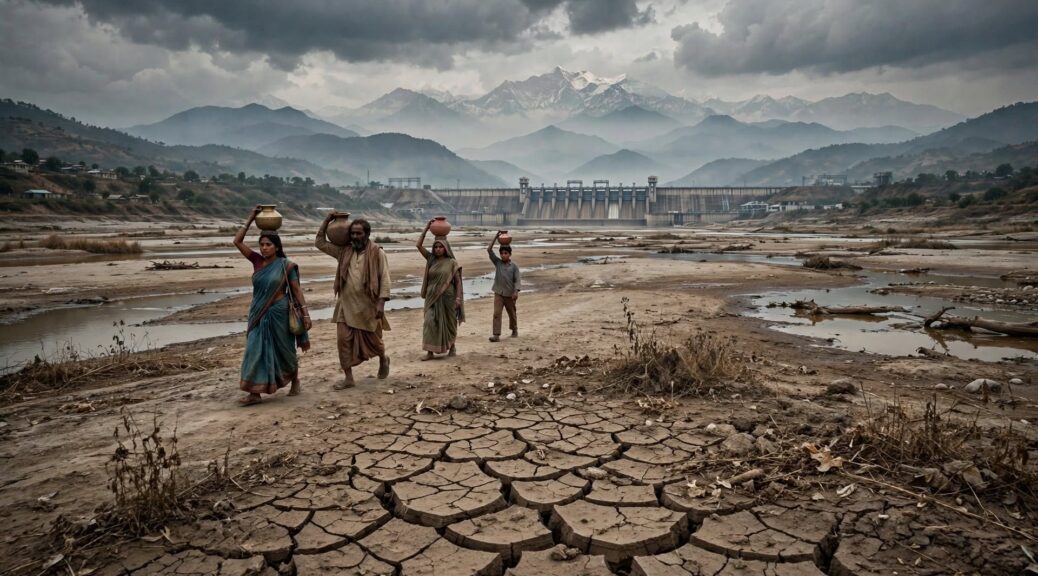
The question, therefore, is not simply whether there will be water. The real questions are: When will it arrive? How much will arrive? And will it arrive when people, farms, cities and ecosystems need it? Because water arriving at the wrong time can be almost as devastating as no water at all. Sometimes it comes marauding down the valleys, swallowing villages and towns and turning them into watery graves. Sometimes it vanishes, leaving nothing but cracks across parched fields.
The Himalayas are becoming unstable
As ice disappears, slopes that have been frozen together for centuries can become unstable. Glacial lakes expand. Moraine dams become vulnerable. Rock and ice can collapse into glacial lakes, creating the potential for another August 26 and another, and another.
The August 26 catastrophe near the Nepal–China border was a brutal reminder. A collapse of rock and glacier ice can crash into a glacial lake, unleashing a devastating flood and sending a cascade of debris downstream. It was not technically a GLOF, but it demonstrated something equally important; a destabilizing cryosphere can generate cascading hazards that may not fit neatly into our bureaucratic categories. The distinction between glacier collapse, landslide, ice avalanche and GLOF may be scientifically important. To people living downstream along the river basins, it is simply another scene of horror. The water, rocks and ice arrive anyway.
Recent UN warnings are stark. Millions of people across the region may be exposed to increasingly dangerous glacial and cryospheric hazards. And the danger is not confined to Nepal. India’s Sikkim has identified 40 high-risk glacial lakes, including 16 in the highest-risk category. The South Lhonak GLOF disaster, and the price people paid, remains fresh in the memory of Sikkimese communities.
The Indus and Ganges: A Reason to Be Nervous
The Indus basin is heavily dependent on glacier melt during the dry season. Earlier IPCC, Intergovernmental Panel on Climate Change, assessments figured out glacier melt contributions at around 41 percent in the Upper Indus, compared with about 11.5 percent in the Ganges and 16 percent in the Brahmaputra. This numbers tell us something important. The Indus is particularly exposed to changes in the cryosphere. Pakistan’s agriculture is deeply dependent on the Indus irrigation system.
That is not science fiction. It is a water-security crisis unfolding in slow motion. The danger is not that the Indus will suddenly dry up. It is that its flow becomes unpredictable. The Ganges is different. It would be bit far-fetched to suggest that melting Himalayan glaciers alone will turn the Gangetic plain into a desert. The Ganges receives a large share of its water from monsoon rainfall. But that is precisely why variability matters. What happens when rainfall becomes more erratic, extreme rainfall becomes more frequent, temperatures rise, snow patterns change and glacier melt becomes less predictable? The river will not necessarily extinct. But the river regime may change. And that distinction is crucial.
South Asia has spent centuries adapting its agriculture, settlements and livelihoods to a particular rhythm of water. Climate change is changing that rhythm.
South Asia has another ingenious response to water scarcity: we drill holes. If the river does not provide enough water, pump groundwater. If groundwater declines, drill deeper. If it declines further, drill deeper still. Brilliant. We have turned a water crisis into a race to the bottom.
It is an excellent short-term solution. It is also a remarkably efficient way of sending the bill to our children. Groundwater is not an underground ocean. It is a bank account. Withdraw faster than Nature can replenish it, and eventually the account runs dry.
So we may end up doing something spectacularly clever: melting the water stored in the mountains while pumping away the water stored beneath the plains. Two accounts. Two withdrawals. One generation spending both. Then we can stand around, scratching our heads, wondering where the money went.
The crisis will end up in the dinner table
Himalayan cryosphere change is not merely an environmental issue. It is an agricultural issue. A food-security issue. An economic issue. And eventually, a political issue.
The great plains of South Asia are among the world’s most densely populated agricultural landscapes. Their food systems depend on a complicated combination of monsoon rainfall, rivers, snow and glacier melt, reservoirs and groundwater. Change that equation, and food production becomes riskier. Riskier agriculture means higher costs. Higher costs mean higher food prices. Higher food prices hit poor households first.
And when water and food become uncertain, people move. Migration puts pressure on cities. Competition for land and water intensifies. Governments discover, usually rather late, that climate change was never merely an “environment ministry” problem. It was always a governance problem.
Then comes geopolitics. There is an even more uncomfortable question. The Himalayan rivers cross borders. Water does not. Politics does.
China, Nepal, India, Bhutan, Bangladesh and Pakistan share river systems originating in, or influenced by, the Hindu Kush Himalaya. Today we argue about dams, hydropower, irrigation, diversion, river treaties and data. Tomorrow we may increasingly argue over something more fundamental: who gets the water when the water becomes less predictable?
A treaty cannot negotiate with a melting glacier. A diplomatic statement cannot stop a GLOF. A border cannot stop a river. And no government can manufacture water by issuing a press release.
South Asia already has enough geopolitical tensions. It cannot afford another one.
The absurdity of our preparedness
There is something almost comical about our response. We have satellites watching glaciers from space. We can map glacial lakes. We can measure snow. We can model flood risks. We can issue early warnings. We hold climate conferences. We produce strategies. We write declarations. We establish committees. And then a mountain collapses and reminds us that nature has not read our documents.
The problem is no longer that we know too little. Increasingly, we know enough and are doing too little with what we know.
ICIMOD has now called for coordinated, standardized monitoring of glaciers, snow, and permafrost across the HKH, precisely because river flows are becoming increasingly unpredictable and cryosphere-related hazards are intensifying. That should not be treated as another report to be placed politely on a shelf.
It should become a regional security agenda.
The water tower needs a maintenance plan
South Asia needs real-time monitoring of glaciers and dangerous lakes. It needs transboundary sharing of hydrological information. It needs GLOF and flash-flood early-warning systems that reach ordinary people. It needs climate-resilient infrastructure. Less water-thirsty agriculture. Groundwater recharge and aquifer management. Aquifers are Nature’s underground savings accounts. We are spending them faster than Nature can refill them.
And, desperately, we need a new form of regional water diplomacy.
Most importantly, we need to recognize that Himalayan water is not an endless inheritance. It is a shrinking natural asset. The Himalayas have supplied South Asia with water for thousands of years. We behaved as though Nature had signed us a supply contract with no expiry date. It has an expiry date.
We cannot stop every glacier from melting tomorrow. But we can slow the warming. We can prepare communities. We can redesign vulnerable infrastructure. We can make agriculture less thirsty. We can replenish groundwater. We can share information instead of guarding it like a military secret. And we can start discussing a South Asian water-security framework before the crisis forces us to.
Because otherwise, the sequence is painfully predictable.
First, the mountains give us violent floods. Then rivers become increasingly erratic. Then dry-season flows become less reliable. Then groundwater declines. Then agriculture suffers. Then food prices rise. Then people move. Then governments start fighting over water. A dystopian script? Perhaps. Unfortunately, parts of it are already being written. The question is whether we have the wisdom to change the ending.
The Himalayan crisis is therefore not simply about melting ice. It is about the slow dismantling of the natural infrastructure that has regulated South Asia’s water for centuries. The mountains are warning us. Their message is remarkably simple; You cannot keep melting the reservoir and expect the river to remain the same.
South Asia has spent centuries learning how to live with floods. It must now learn to live with something far more complicated; Too much water today. Too little tomorrow. And uncertainty in between.
2500 words