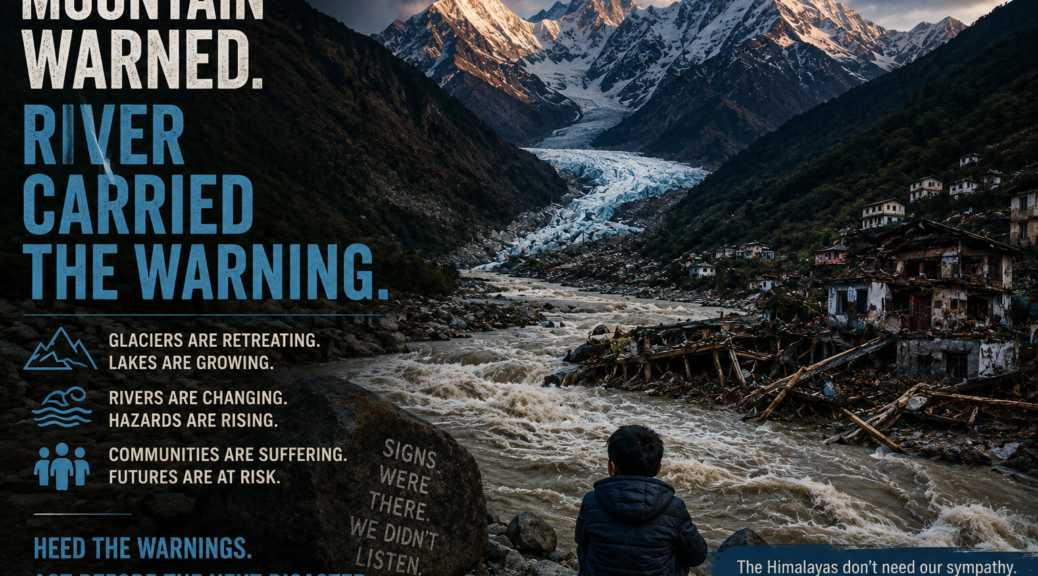
The Mountains Warn. The Rivers carry the Warning
The Mountains Warn. The Rivers carry the Warning
Prakash Dahal
The Himalayas have this uncanny way of warning us and then making us pay through the nose for ignoring the warning. The August 26 calamity was merely the latest of several warnings we chose not to heed. But the facts now emerging make the August 26 catastrophe even more sinister. This was not simply a sudden flood; the kind of calamity Grandpa might have recounted as a grim tale to children huddled around the hearth on a wintry evening.
It appears to have been a cascading chain of mountain failures. A massive ice-rock avalanche or glacial collapse dumped enormous quantities of ice, rock, mud and debris into the Lhende River on the Tibetan side, blocking the river and creating a temporary barrier lake. The river was blocked; water accumulated behind the debris, forming a temporary barrier lake and when the natural dam could hold no more, it broke. And the water, ice, mud and debris exploded downstream into the Bhote Koshi and Trishuli systems.
The mountain broke, the river was dammed, a lake was born and then the lake came crashing down. Satellite evidence and preliminary scientific analyses increasingly point to an ice-rock avalanche as the trigger. In other words, what looked initially like an earthquake-induced flood is emerging as something more frightening; a cryospheric cascade. And the danger did not end when the first wall of water passed. A new barrier lake subsequently formed upstream from the disaster site, reportedly holding millions of cubic meters of water. Authorities warned of another possible outburst. One disaster, therefore, has produced another latent disaster.
The mountain has not finished speaking. And its message is loud enough to rupture the eardrum; this is not merely Nepal’s problem. That is where the Bhote Koshi story must now travel beyond Nepal.
The Himalayas do not recognize political borders. A glacier can collapse in Tibet. A debris dam can form in one country. A lake can burst across another. A river can carry the consequences into India and Bangladesh. The river has no passport. That is why the growing concern in Sikkim, India, deserves far more attention than it is receiving. The Sikkimese understand the message delivered by the catastrophe in the Lhende–Bhote Koshi corridor that the river knows no border, but New Delhi may still see the devastation as collateral damage in the pursuit of development.
One may well wonder; why are the Sikkimese suddenly sounding the alarm? The Bhote Koshi catastrophe has spurred groups in Sikkim to demand that New Delhi halt new hydropower projects and undertake an independent review of the safety and environmental consequences of hydropower development in the Himalayan state. The demand is particularly significant because the Sikkimese have already lived through the devastation of the October 2023 South Lhonak GLOF, which destroyed the 1,200 MW Teesta III hydropower project and sent destructive flows downstream. The message from Sikkim is therefore becoming unmistakable.
Perhaps the question is no longer whether we can build a dam with all our state-of-the-art technology. The question is whether the mountain has given its consent. That is a very different question. What happens in Sikkim does not end in Sikkim? The Teesta is the perfect example.
It rises in the Himalayas, flows through Sikkim and West Bengal, and eventually empties into Bangladesh. The Teesta basin supports an estimated 30 million people, with over two-thirds of its population living in northwestern Bangladesh. For Bangladesh, therefore, what happens in the upper Himalayas is not remote mountain news to be consumed over a morning coffee. It is alarming and poses an imminent threat downstream. The 2023 South Lhonak disaster already demonstrated this deadly connectivity. A GLOF destroyed infrastructure in Sikkim, raced downstream and affected areas beyond India, including Bangladesh.
Now imagine a future in which glacier collapse, unstable slopes, barrier lakes, extreme rainfall, and hydropower infrastructure interact more frequently. The danger is not merely a flood. It is cascading failure. A glacier falls. A river is blocked. A lake forms. The barrier breaks. The flood hits a hydropower project. The project fails. Its stored water and debris add to the flood. Another structure downstream is overwhelmed. The catastrophe grows larger with every kilometer, triggering a domino effect downstream. This is precisely why conventional environmental-impact assessments can become dangerously inadequate. They tend to examine projects one by one. Nature does not.
The Teesta cannot be managed as a national river. India and Bangladesh have spent years haggling over the Teesta, largely treating it as a water-sharing issue. That conversation is no longer enough. The Teesta must also be treated as a shared climate-risk system. Bangladesh has little influence over what happens to glaciers, slopes, dams and reservoirs hundreds of kilometers upstream. Yet it is left to bear the consequences. The farmer in northern Bangladesh or West Bengal did not approve the dam. He did not destabilize the glacier. He did not warm the atmosphere. He did not build the road or tunnel. And yet, he may be the one standing neck-deep in floodwater when the consequences come crashing down. That, perhaps, is the bitter joke of climate justice; those who have done the least to create the problem are often the first to pay for it.
And where does climate finance fit? This brings us back to the UN’s Green Climate Fund. GCF’s Nepal project, FP272, was approved in July 2025, with $36.16 million in GCF grant financing to reduce risks from GLOFs and climate-induced flooding. It became effective in March 2026. Nobody can therefore seriously argue that the GLOF threat was unknown. The risk had been recognized. Money had been approved. Projects had been designed. Warnings had been issued. And yet, the Bhote Koshi happened.
The question is not whether one GCF project could have prevented the disaster. That would be too simplistic. The harder question is this. Are climate-finance institutions and governments designing their response around the actual, rapidly changing Himalayan hazard or around the neat boundaries of projects, jurisdictions, and bureaucratic mandates? A glacier does not understand a project boundary. A barrier lake does not wait for procurement. A landslide does not consult a donor calendar. And a flood does not stop at an international border.
The Himalayas need one warning system. The answer cannot be another conference followed by another declaration. Nepal, India, Bangladesh and China need a genuinely transboundary Himalayan early-warning architecture. Shared satellite monitoring. Shared glacier and glacial-lake surveillance. Real-time hydrological data. Immediate warnings of dangerous lake formation or sudden upstream blockage. Joint flood modelling. Common protocols for downstream evacuation. And, above all, a new standard for Himalayan infrastructure that recognizes cascading hazards rather than treating each dam, road, and settlement as an isolated project.
The Sikkim demand for a fresh examination of hydropower development should therefore not be dismissed as an anti-development campaign. It should be treated as a warning.
The question is not whether South Asia needs electricity. It does. The question is whether we are building twenty-first-century infrastructure on the assumption that the Himalayas of yesterday still exist. They do not. The glaciers are changing. The slopes are changing. The rivers are changing. And the hazards are becoming more interconnected.
The greatest mistake now would be to treat Bhote Koshi as another natural disaster, issue condolences, announce relief, rebuild what was destroyed and wait for the next mountain to fall. The next mountain may fall in Sikkim. The next barrier lake may form somewhere else. The next flood may travel into Bangladesh. And the next cascading disaster may make Bhote Koshi look like a rehearsal.
The Himalayas have already given us the warning. The question is whether South Asia will finally understand what the river has been telling us. A disaster that begins upstream does not belong to the country where the mountain happens to collapse. The mountain has no passport. The glacier has no border. The river has no nationality. And the people downstream have no choice. So how many more warnings must the mountains send before we finally listen?