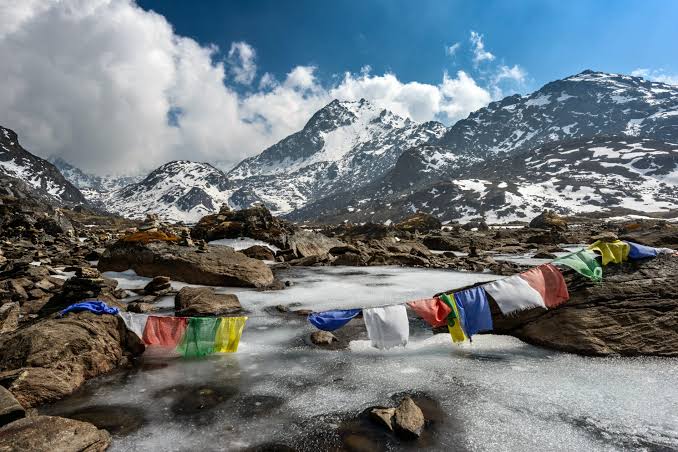
The Red Flags Are Flying in the Himalayas Behind the Breathtaking Ice, Disaster Is Lurking!
High above us, below the blue, behind the milky curtain of the Himalayas, a disaster is brewing—unseen by most, visited by few, understood by fewer, and met with the blissful ignorance of many. It is unfolding in a frozen wilderness that seems remote, silent, and eternal — serene on the surface, but changing furiously beneath it, like a quiet duck paddling frantically below the water.
The glaciers are shrinking, the snow is sweating, and glacial lakes are swelling like they have discovered an all-you-can-drink buffet. New lakes are appearing, while old ones are spreading their waistlines. Some of these growing pool of water are held back by little more than precarious walls of ice, rock, mud and debris—nature’s capricious dams, looking solid until they suddenly aren’t.
Caution! Behind the Himalaya’s breathtaking white façade lurks a disaster waiting for the wrong shove. An avalanche, landslide or icefall could be all it takes to upset one of nature’s capricious dams—and send a furious wall of water, boulders, mud, and debris charging down the valley.
To many a great mind with plenty of grey matter between their ears in Kathmandu, Delhi, Dhaka and those breathing in the plains of the Ganges and Brahmaputra, some glacial lake thousands of meters above sea level may seem safely tucked away in somebody else’s backyard. It is not. The Himalaya and the plains are joined by rivers, not by political borders. What happens to the ice above eventually comes downhill—and it does not stop to ask whose government is in charge!
For those flying in from afar, with state-of-the-art cameras slung around their necks, the Himalaya is a breathtaking spectacle—something to zoom in on, fly over and take home as a postcard and Instagram moments. For South Asians, however, the mountain is not a postcard; it is the water tower on which their lives depend, and increasingly, a source of anxiety because what happens backstage can eventually wash across the stage below. The Himalayas have been our oldest and most reliable public utility, providing water to millions without charging a paisa, filing a tender or demanding a cabinet meeting. Now, the alarm bells are ringing from the snowy wilderness: South Asia’s great water tower is changing. Unfortunately, the warning seems to be reaching ears so thick that even a GLOF may struggle to get through.
Climate change is turning up the heat on the Himalaya faster than our minds can process, let alone our policies respond. The cryosphere—the planet’s frozen realm of glaciers, snow, ice and permafrost—is crying out from the rooftop of the world, its distress signals visible to the naked eye. But down below, our policymakers seem to be suffering from a curious epidemic of selective deafness.
The evidence no longer needs scientists to wrestle with mountains of data or decipher Byzantine graphs. The mountains themselves have become the data and the graph is now written across their melting faces.
ICIMOD’s major assessment of the Hindu Kush Himalaya found that glaciers disappeared 65 percent faster during 2011–2020 than during the previous decade. Its more recent assessment reports that the rate of glacier ice loss has since accelerated further.
As glaciers retreat, depressions left behind by the ice can fill with meltwater. Glacial lakes grow. Some are relatively harmless. Others sit in precarious locations, behind unstable moraine dams. That is where the trouble begins.
ICIMOD’s red-flag inventory identified 21 potentially dangerous glacial lakes in Nepal across the Koshi, Gandaki and Karnali River basins. Many are bulking up with meltwater, while those in the know continue to watch them swell with admirable patience. Tsho Rolpa and Imja, two of the country’s most notorious troublemakers, have even had their water levels lowered to tame them. Yet both refuse to be tamed, continuing to swell behind their fragile walls. Perhaps the lakes, unlike governments, have little respect for mitigation plans.
These are certainly not lakes for surfing, canoeing or posting cheerful holiday selfies. Think of them instead as giant mountain reservoirs, perched thousands of meters above our heads and held back by nature’s rather capricious engineering. They are closer to the kind of monsters Odysseus might have expected on his long, troubled journey home from Troy than to a well-behaved municipal reservoir, except that these reservoirs come without engineers, gates, control rooms or emergency switches. When their fragile walls give way, there is no operator to pull a lever, no engineer to turn a valve and, unfortunately, no Odysseus to steer us out of trouble. There is only gravity—and gravity, as we know, has never been particularly good at negotiating. A GLOF does not require someone to press a button.
A landslide can come crashing into a lake like an uncouth bull in a china shop, smashing into whatever happens to be in its way. A rock avalanche can shove an enormous volume of water out of its way, while an ice avalanche can deliver an even more violent punch. Then comes intense rainfall, quietly weakening the surrounding slopes and the already capricious moraine dam. Nature, it seems, has several ways of knocking on the door, and interestingly, none of them involve asking permission. Once that fragile dam gives way, the stored water needs no further invitation. Gravity takes over, and the whole mountain drama heads downhill at terrifying speed.
The 2024 Thame GLOF was a terrifying teaser of the Himalayan horror story that nobody bought a ticket for. At about 4,900 meters, a rock avalanche crashed into a glacial lake, generating a displacement wave that breached the lake and released around 156,000 cubic metres of water. The flood tore through much of Thame, leaving behind a brutal reminder that the mountains can produce their own special effects—with no director shouting “cut.” For communities downstream, the message should be obvious: Thame was only a teaser—there may yet be a far more consequential Himalayan Odyssey waiting downstream. The lesson is painfully simple: a glacial lake does not need to be enormous to cause enormous damage. Nepal has recorded 26 GLOF events since 1977, with 11 having transboundary impacts. The warning, therefore, is not only for the people living beside a glacier-fed stream in Solukhumbu, Manang or Dolakha. It is also for people living much farther downstream.
The catastrophe can travel downhill. Imagine a GLOF originating high in the Himalaya. What begins as a mountain disaster can quickly become a downstream catastrophe! At first it is a mountain disaster, then it becomes a river disaster, then an infrastructure disaster, then an economic disaster, and, finally, a regional disaster! Once a monstrous flood gets loose in a major river system, little in its path is safe. It can smash hydropower installations, rip apart highways and bridges, swallow settlements and farmland, cripple irrigation, choke tourism and trade, contaminate drinking water and leave communities stranded like islands.
So, the real question is not whether a lake could burst, but whether we can predict how much water it could unleash, how far the flood could travel, and what—and whom—it could destroy along the way.
This is where hazard modelling, risk mapping, real-time monitoring and early-warning systems cease to be academic exercises for international conferences in posh resort auditoriums or PowerPoint slides in comfortable university classrooms. High in the mountains, they can become matters of life and death. A beautifully colored hazard map may look impressive on a conference screen, but it will not save a villager if the warning arrives five minutes after the flood.
Nepal’s National Adaptation Plan already recognizes the need to assess potentially dangerous lakes, map downstream communities and infrastructure, establish real-time monitoring and strengthen GLOF early-warning systems. But, the question is no longer whether we know what needs to be done! The question is whether we are doing it fast enough.
There is another danger, less dramatic than a GLOF but potentially far more profound: the changing hydrological regime. For a while, rapid glacier melt can actually mean more water. It may even look like nature has suddenly become generous. But it is a gift with an expiry date. As the glaciers lose mass, the bonus water cannot keep flowing forever. The ice reservoir is being spent down. And once the reservoir begins to shrink, so does the long-term supply. This leaves South Asia facing a cruel paradox: too much water in the wrong place and at the wrong time, followed by too little water when and where we desperately need it. The Himalaya may first shower us with too much water and then, rather rudely, turn off the tap. It is generosity with a hidden bill—less a gift from the mountains than a Trojan horse delivered with a smile.
As an upper-riparian country and home to eight of the world’s highest peaks, Nepal sits atop an enormous storehouse of ice. It can no longer claim ignorance of the danger unfolding in its own backyard. It has a National Climate Change Policy. It has a National Adaptation Plan. It has disaster-management institutions. It has scientific institutions. It has years of experience with GLOF monitoring and mitigation.
So the problem is not the complete absence of policy. The problem is fragmentation, urgency, and implementation. The Himalaya needs to move from being a chapter in a climate policy to becoming a national security, water security, and development priority.
Nepal needs a much stronger, integrated national framework for the cryosphere and mountain ecology—one that brings together glacier science, GLOF risk, biodiversity, water resources, disaster management, hydropower, infrastructure planning and mountain livelihoods. At present, too many institutions appear to be holding different pieces of the same jigsaw puzzle. The mountain does not care which ministry has which piece.
Nepal’s new government, led by Prime Minister Balendra Shah—a structural engineer by training—has an unusual advantage. He should know better than most that a structure can look rock-solid right up to the moment the forces acting on it quietly exceed its load-bearing capacity. The Himalayas, unfortunately, do not issue warning letters before they crack.
The real question, then, for a new government swept into power by a Gen-Z uprising and led by a millennial Prime Minister is simple: will cryosphere change become yet another policy file to be passed from ministry to ministry until the glaciers melt—or will the government finally treat it as the emergency it is?
To start with, the Government should create a high-level National Cryosphere and Mountain Risk Council, answerable directly to the Prime Minister—not another committee destined to gather dust in a government cupboard. It should bring together hydrologists, glaciologists, geologists, meteorologists, disaster experts, ecologists, engineers, local governments and, most importantly, the mountain communities living on the front line of a crisis that will not wait for bureaucratic files to move. It should create a national, publicly accessible Glacial Lake Risk Register.
Nepal has traditionally been rather good at responding to disasters—and remarkably poor at preventing them. The script is almost comically predictable: disaster strikes, officials arrive, helicopters take to the sky, relief materials follow, committees are formed, reports are written, and, after everyone has been photographed, the nation moves on.
But even the wisest man with a bald head and snow-white beard should understand one elementary truth: a siren is useless if nobody knows what it means; an early-warning message is useless if there is nowhere to run; and an evacuation route is useless if the bridge has already decided to float away. And a beautifully printed disaster-management plan gathering dust on a government shelf? That is not preparedness—it is expensive wallpaper.