The Himalayas Warned Us. We Looked Away.
Born in the frozen heights of Tibet, the Bhotekoshi came roaring down through the Himalayas on August 26, its fury unleashing death and destruction on a scale Nepal had seldom, if ever, witnessed. The river did not merely flood. It came down like a wall. Water, ice, rock, mud and debris tore through the valley on August 26, sweeping away bridges, roads, buildings, vehicles and livelihoods. Buses and jeeps that normally carry people through this Himalayan corridor were tossed around like toys. Infrastructure that had taken years to build vanished within minutes, taking men, women and children with it, indiscriminately, mercilessly.
Families are still waiting, clinging to the faint hope of hearing from loved ones who may never return. Communities have been torn apart, their lives buried beneath mud, debris and wreckage. Rescue workers sift through the ruins, searching for the missing while risking their own lives amid unstable slopes, the threat of further landslides and newly formed water bodies upstream. The scale of the devastation is almost beyond comprehension; the images are difficult to look at, let alone absorb.
But perhaps the most disturbing thing about this cryospheric catastrophe is not how sudden it was. The danger was anything but sudden. The warnings had been piling up for years; scientific warnings, environmental warnings, the unmistakable signs of a changing cryosphere and, just weeks ago, the July 17 Nagarkot Call for Action. Yet we still failed to listen. What was sudden was not the danger, but our willingness to pretend we had not seen it coming. The catastrophe was sudden. The warning was not.
The Bhote Koshi disaster is a grim reminder that the climate crisis is no longer some abstract threat waiting for us in the distant future. It is here, tearing through Nepal’s Himalayan corridors, destroying lives and livelihoods in its path. In the Himalayas, it is becoming a question of whether a mountain will remain standing long enough for the people below it to get out of the way.
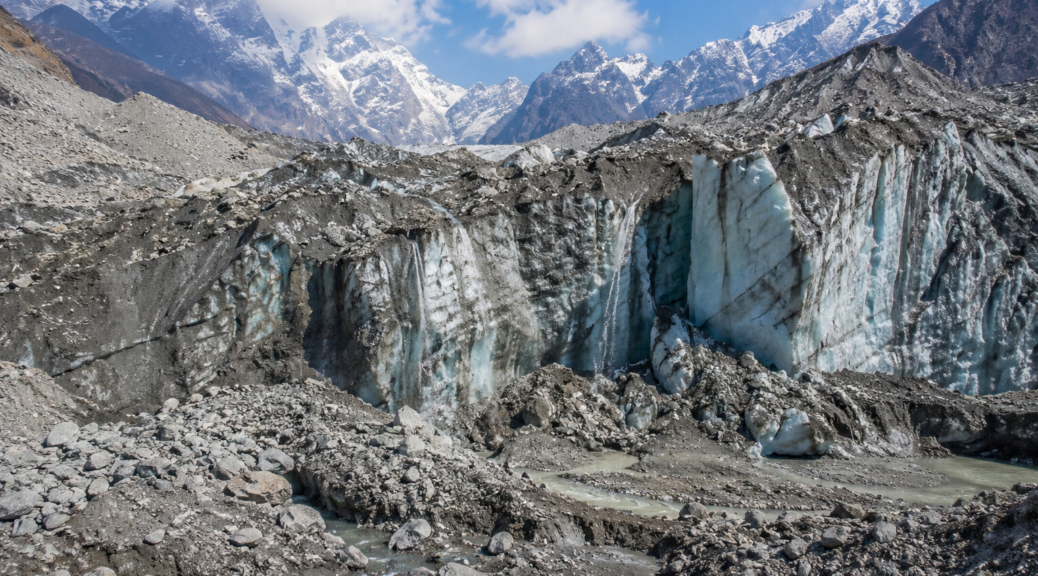
Scientists are still piecing together the precise chain of events that unleashed the catastrophe. Early assessments pointed to an ice avalanche, rock fall or debris avalanche that temporarily blocked the Lhende River, followed by a catastrophic release of water and debris. Satellite imagery and subsequent analysis have increasingly pointed to a glacier collapse and ice-rock avalanche as the trigger. Whether the final scientific label is GLOF, ice-rock avalanche, landslide-induced flood or some cascading combination of these hazards matters greatly to scientists. To the people downstream, however, the distinction is brutally simple, “The mountain collapsed. The river exploded. People died.”And it happened in a region where scientists, governments and environmental organizations have been warning for years that a warming Himalaya is becoming increasingly unstable.
On July 17, just six weeks before the Bhote Koshi catastrophe, a gathering of scientists, glaciologists, hydrologists, policymakers and civil-society leaders in Nagarkot, Nepal, warned of the mounting dangers of a rapidly changing Himalayan cryosphere. The warning could hardly have been more timely or more prophetic.
The conference, organized by Friends of the Earth Nepal, was certainly no gathering of climate romantics sipping coffee and admiring melting glaciers from the comfort of a safe distance. From the bald-headed to the Gen-Z, they gathered under the roof of Mystique Mountain to ponder a rather inconvenient question; what happens when the Himalayan ice melts, glaciers retreat, glacial lakes swell and the consequences come roaring downstream?
They did not hide their light under a bushel. They sounded the alarm, issuing the Nagarkot Call for Action on Climate Justice and a ten-point declaration demanding urgent action. The message could not have been clearer; the Himalayas are changing. The risks are changing with them. The only thing that seems stubbornly refusing to change is the response of governments and the international community.
And six weeks later, the Bhote Koshi delivered a devastating demonstration of what that warning meant in the most brutal way imaginable. It is tempting to call this a tragic coincidence. It is more uncomfortable to call it what it looks like; a warning that was not heeded and acted upon with anything approaching the urgency it deserved. The mountains had spoken in scientific language. The river translated it into human suffering.
This was not the first warning. Nepal has been here before. The 2024 Thame disaster was not merely a tragedy; it was a warning. An avalanche plunged into a glacial lake, generating a displacement wave and unleashing a destructive flood downstream. ICIMOD’s grim assessment painted an even more alarming picture. The event released roughly 156,000 cubic meters of water and identified the Everest region as a GLOF hotspot requiring urgent, proactive risk management. The science was clear. The warning was unmistakable. Apparently, the urgency was lost somewhere between the report and the response. In July 2025, flooding in the Lhende River near the Nepal-China border was attributed by Nepal’s Department of Hydrology and Meteorology to a glacial lake outburst.
And in July 2025, the Green Climate Fund approved $36.1 million to help Nepal reduce risks from glacial lake outburst floods, including strengthening early warning and protecting mountain communities. That last fact should make the international community uncomfortable. Because it demonstrates that the risk was recognized at the highest level of global climate finance. The problem was not ignorance.
The problem is whether the response is happening at sufficient scale, in sufficient places, and at sufficient speed. There is a cruel mismatch at the heart of climate adaptation. Climate institutions speak in years. Glaciers operate in decades. Avalanches operate in seconds.
A project can spend years moving through approvals, procurement, implementation and reporting. A mountain can collapse before the first sensor is installed. That is the absurdity we must confront. The climate crisis is accelerating while the institutions designed to respond to it are still moving at bureaucratic speed.
The Green Climate Fund was created to help developing countries confront climate change. Nepal is precisely the kind of country for which such support should matter. It contributes very little to global greenhouse-gas emissions, yet its mountains are warming, glaciers are retreating and cryosphere-related hazards are becoming increasingly dangerous. The GCF can rightly point to its approved Nepal projects.
But vulnerable communities are entitled to ask a harder question, “Is the money arriving fast enough, and is it reaching the hazards that are actually emerging? That is not an accusation against one institution alone. It is a question for the entire international climate-finance system. A climate fund cannot measure success simply by the number of dollars approved. Nor can it measure success by the number of project documents completed. The real test is whether a village is safer. Whether a dangerous glacial lake is being monitored. Whether a warning reaches a family before the flood arrives. Whether a bridge has been built to withstand the hazard of the future rather than the climate of the past. Whether a community has somewhere safe to evacuate to. Whether a life is saved. That is what adaptation finance is ultimately supposed to buy.
There is something almost grotesque about the way the world finances climate adaptation. A vulnerable country submits a proposal. Experts examine it. Committees deliberate. Safeguards are reviewed. Budgets are negotiated. Documents are revised. Approvals are granted. And while the paperwork moves at its stately pace, the climate does not wait. It wears no watch, and certainly has none of the patience of the world’s bureaucratic gatekeepers.
Meanwhile, the physical climate system is not waiting for the paperwork. A glacier does not understand a funding cycle. A landslide does not wait for procurement. A glacial lake does not extend its deadline because a donor has not completed its review. The bureaucracy has a calendar. The mountain has gravity. And gravity is notoriously impatient. This is why the international community needs to rethink what climate finance means in high-risk mountain environments.
For Nepal, adaptation finance is not primarily about planting a few more trees or producing another climate strategy. It is about seeing danger before it becomes disaster. It means monitoring glaciers and glacial lakes continuously. It means satellites, sensors, cameras, hydrological stations and real-time data. It means mapping unstable slopes and avalanche sources. It means connecting scientific information directly to local warning systems. It means evacuation routes and drills. It means relocating people and critical infrastructure when staying put becomes indefensible. And it means financing all of this before and not after the next catastrophe.
Resource-starved Nepal has thousands of glaciers and glacial lakes spread across some of the world’s most difficult terrain. An ICIMOD-UNDP inventory identified 2,070 glacial lakes in Nepal’s Koshi, Gandaki and Karnali basins alone and identified 21 potentially dangerous lakes in Nepal. No low-income country can reasonably be expected to monitor every changing glacier, lake, slope and avalanche source by itself.
This is precisely where climate justice should become something more than a diplomatic slogan. Nepal needs international finance. It needs satellite technology. It needs scientific cooperation. It needs technical capacity. It needs early-warning infrastructure. It needs loss-and-damage support. And it needs these things before the next wall of water comes down the valley.
The stakes extend far beyond the mountains. The Hindu Kush Himalaya feeds the rivers on which hundreds of millions of people across Asia depend. What happens in the high mountains does not stay there; it comes roaring downstream. A destabilizing glacier in the Himalayas is not simply a Nepalese problem. It is a regional problem. Ultimately, it is a global climate problem.
The Bhote Koshi disaster has ripped open a gaping hole in the international response; the Himalayas do not respect political boundaries. A glacier does not need a visa to collapse into a river flowing across a border. An avalanche does not need a permit to block a river in one country and unleash destruction in another. Nature crosses borders with effortless impunity; our institutions, treaties and response mechanisms do not. A temporary lake can threaten communities hundreds of kilometers downstream without asking permission or giving so much as a warning.
The real question, therefore, is not whether we were warned. It is tempting after every disaster to ask whether anyone could have predicted it. That is not quite the right question. The better question is; Did we know enough to act? We did. We knew the Himalayas were warming. We knew glaciers were retreating. We knew glacial lakes were changing. We knew GLOFs could be devastating. We knew cascading hazards could produce floods far more destructive than ordinary rainfall floods. We knew communities and infrastructure were exposed. We had scientific assessments. We had conferences. We had declarations. We had warnings. And now we have the wreckage of Bhote Koshi.
That does not mean the disaster could necessarily have been prevented. Nor does it mean that one climate fund, one government or one scientific institution could have stopped it. It means something more uncomfortable. The world knew enough about the direction of risk to justify far greater urgency.
For countries with deep pockets, climate adaptation can be an investment opportunity, a resilience strategy or simply another line in the national budget. For a Himalayan family living beneath an unstable glacier, it is rather less sophisticated; the right to survive. That is why climate justice cannot be reduced to haggling over percentages and pledges while the mountains keep melting.
It must be measured in lives protected. The people who contributed least to global warming should not have to pay the highest price for it. And they certainly should not have to wait until after catastrophe for the international community to discover its compassion. The world is often extraordinarily generous after disaster. Emergency funds are announced. Condolences are issued. Aid packages arrive aboard C-130 Hercules and C-17 Globemaster aircraft. But there is something deeply perverse about a system that becomes most generous only after the preventable part is over. The real measure of international solidarity is not how quickly we respond to the dead. It is how seriously we protect the living.
The August 26 catastrophe should therefore become a turning point. Nepal needs a permanent national Himalayan cryosphere and GLOF monitoring system, with adequate financing and direct links among scientists, glaciologists, disaster agencies, security forces, local governments and communities. It needs legally enforceable hazard maps and climate-resilient infrastructure standards. It needs a dedicated national mechanism for financing GLOF preparedness, early warning, protective engineering, relocation and community preparedness.
But Nepal cannot finance this transformation alone. The international community must help. And the Green Climate Fund and other climate-finance institutions should be judged not by whether they can demonstrate that they have approved money, but by whether the most vulnerable communities can demonstrate that they are safer because of it. That is the standard climate justice demands. The July 17 Nagarkot conference sent its warning. The Bhote Koshi disaster has now amplified it beyond the conference hall, beyond Nepal and beyond the Himalayas.
The question is whether the world will hear it. Or whether we will wait for the next glacier to fall, the next lake to burst, the next river to rise and the next family to stand beside a pile of debris searching for someone they love, knowing that the river may already have taken them forever. How many more warnings do we need? How many more lives must be lost before climate finance moves at the speed of climate danger? How many more communities must live in harm’s way before climate justice stops being a phrase used in international declarations and becomes a principle reflected in budgets, technology and action?
The people of the Himalayas should not have to die to prove that the Himalayas are warming. They should not have to become statistics to prove that adaptation is urgent. And they should not have to wait for the world’s heart to bleed before the world’s institutions begin to move.
Why not sing the refrain, once again; the mountains warned us. The scientists warned us. The communities warned us. Nagarkot warned us. And on August 26, the Bhote Koshi stopped warning and showed its merciless face.
Now the world has a choice. It can treat Bhote Koshi as another tragic natural disaster and issue condolences, announce emergency funds, send aid and move on, as the world has become remarkably good at doing. Or it can recognize it for what it may be; a warning from the future that arrived early.
More warnings will come. The only question is whether we will continue waiting for them to arrive in the form of death and destruction—or finally act while a warning is still a warning.
The End